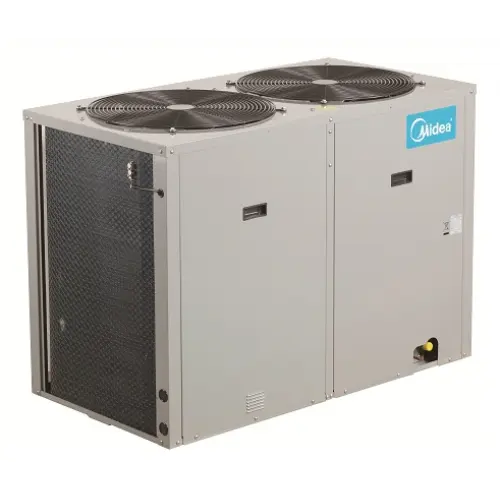
VRF moves refrigerant directly between outdoor and indoor units, while a chiller produces chilled water that pumps distribute to air-handling units or fan-coil units. Either can perform well when matched to project conditions.
How does each system work?
VRF: varies refrigerant flow to match connected zone demand and supports multiple indoor-unit types.
Chiller: cools water centrally and distributes it through pumps and piping to AHUs or FCUs with valves, controls and balancing.
Technical comparison
| Factor | VRF | Chiller |
|---|---|---|
| Typical scale | Small to medium, multi-zone buildings | Medium to large centralized loads |
| Distribution medium | Refrigerant piping | Chilled-water piping |
| Zone control | Inherent individual control | Depends on terminal units and valves |
| Plant space | Outdoor modules and piping routes | Chiller, pumps, network and accessories |
| Maintenance | System-specific diagnostics and refrigerant work | Plant, network, pumps and water-side maintenance |
| Expansion | Limited by capacity and piping rules | Flexible when plant and piping are planned for growth |
When does VRF make sense?
- Many zones have different schedules and loads.
- Individual room control is important.
- Large duct routes are difficult to accommodate.
- Part-load operation is common.
- Piping limits and service access can be satisfied.
When does a chiller make sense?
- Loads are large or operating hours are long.
- The facility can support a central plant and network.
- Many AHUs or FCUs require chilled water.
- Operations staff can maintain the plant and water system.
- Future expansion is included in capacity and piping plans.
How to compare life-cycle cost
Include equipment, piping, ducts, power, controls, plant space and testing, then compare annual energy, service requirements, spare parts, expected life and downtime. The lower first cost is not always the lower long-term cost.
A practical selection process
- Calculate loads by zone.
- Define operating schedules and diversity.
- Confirm piping, duct and equipment locations.
- Compare energy, maintenance and expansion over several years.
- Review technical support and spare-parts availability.
- Finalize the system before architectural and electrical coordination closes.
Review our VRF installation and chiller services.
Frequently asked questions
Is VRF always more energy efficient than a chiller?
No. Energy depends on load profile, diversity, equipment efficiency, controls, climate, installation quality and maintenance.
Is a chiller always better for factories?
Not always. Some factories need packaged units, local process cooling or ventilation-focused solutions depending on heat and contaminants.
Can a project be changed from VRF to chiller?
Yes during design, after reworking equipment, piping, electrical and terminal-unit requirements. A late change can be costly and disruptive.