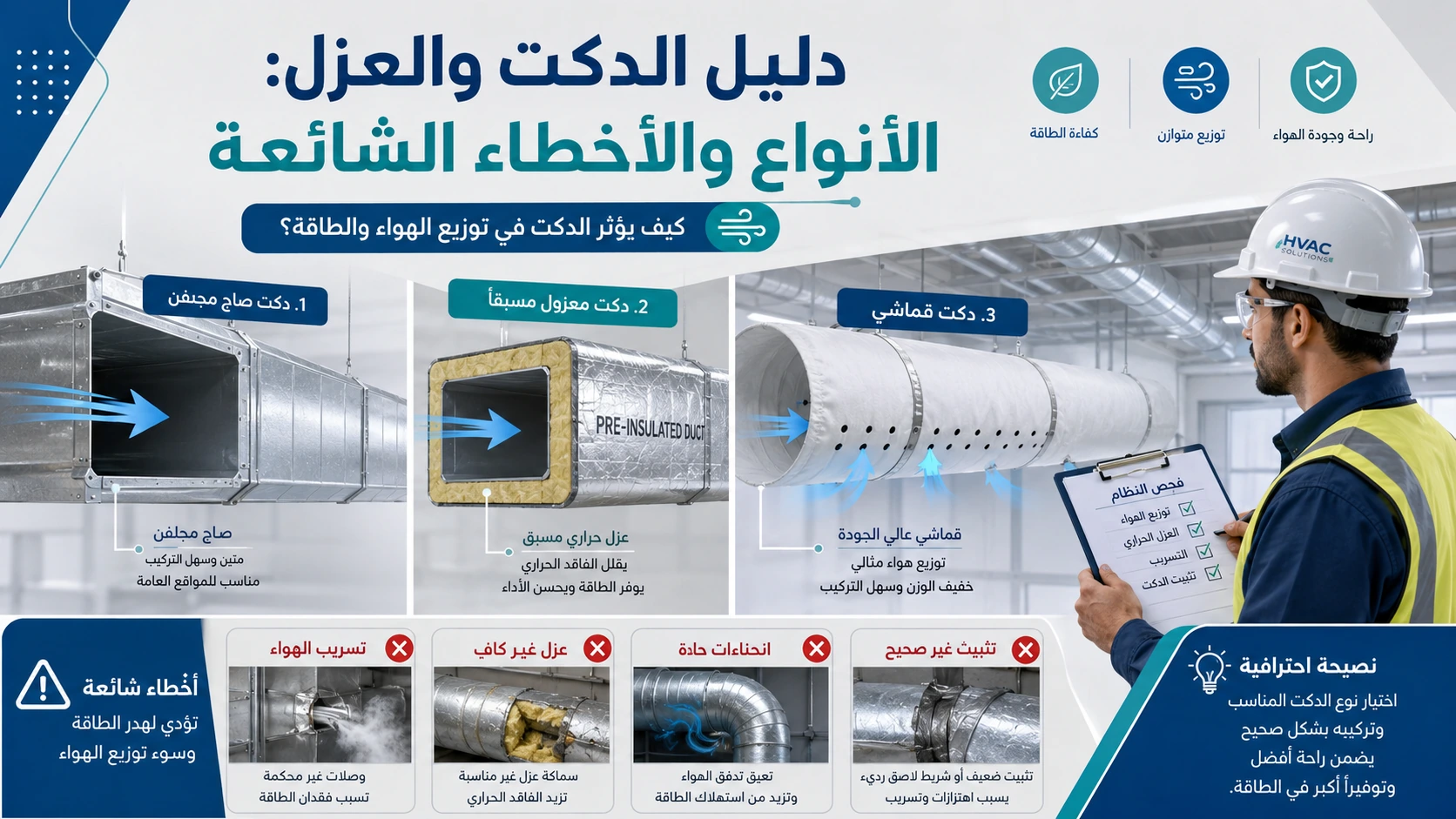
What is the function of the duct?
The duct transports conditioned air between the unit and different areas. The grille must maintain air volume and pressure with as little leakage,noise and heat loss as possible. Therefore,duct sizes are related to air speed,path length,and the number of elbows,branches,and outlets.
Common types of duct
| Type | Use | Notes |
|---|---|---|
| Rectangular galvanized | Most commercial and residential projects | Flexible in sizes and requires good manufacturing and insulation |
| Circular | Exposed factories and designs | It has lower pressure and a distinctive architectural shape |
| Pre-insulated | Light and fast tracks | It needs protection and high quality in cutting and joining |
| My fabric | Halls,factories and some open spaces | Wide distribution,light weight and requires precise hole design |
Thermal and sound insulation
Thermal insulation reduces heat gain and prevents moisture condensation on the exterior surface. The thickness,density and type of vapor barrier are chosen depending on the location of the duct,air temperature and the surrounding environment. Sound insulation addresses the transmission of fan noise and air movement when needed.
Why does air leakage occur?
- Loose connections or inappropriate sealing materials.
- Deformation of the plates or lack of supports.
- Service slots not addressed after implementation.
- Operating pressure higher than the network rating.
Leakage reduces air entering the space and increases the unit's operating time. In important projects,a leak test is conducted before closing the roofs.
Common design and implementation errors
- Using a small size increases speed and noise.
- Sharp elbows and unbalanced branches.
- Neglecting maintenance openings for units and cabinets.
- Press the dict between services and change the clip randomly.
- Damage to the vapor barrier or leaving breaks in the insulation.
- Failure to balance the outputs after operation.
Duct quality checklist
- Matching sizes and levels to drawings.
- Safety of supports and the distances between them.
- Tightening connections and openings.
- Continuity of insulation and vapor barrier.
- Flexible connection with equipment to reduce vibration.
- Easy access to dampers and maintenance openings.
Details can be viewedManufacture and installation of ducts and insulationAnd watchExamples of our projects.
Frequently asked questions
Is a circular duct better than a rectangular one?
Not always;Round is good for pressure and leakage,while rectangular is more flexible in limited spaces. The choice depends on the location and design.
What is the reason for water coming out of the duct?
It could be condensation due to weak or damaged insulation and vapor barrier,or a leak from a nearby drain line,and the source must be identified in the field.
Can the duct be cleaned?
Yes,when there is a proven need and access is available,but it is more important to address the source of dust and moisture and maintain the filters.